
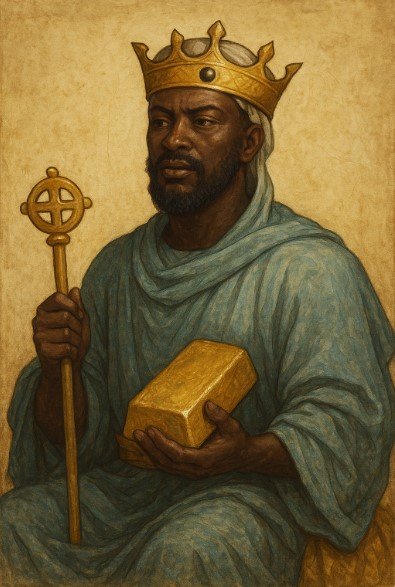
Early Life & Background
- Full Name: Musa Keita I
- Birth: Circa 1280 CE (exact date unknown)
- Birthplace: Mali, West Africa
- Royal Lineage: Keita Dynasty
- Religion: Islam
Mansa Musa belonged to the powerful Keita family, which had ruled Mali for generations. Before he became emperor, he served as deputy ruler under his predecessor, Mansa Abu-Bakr II.
Rise to Power
Musa became Mansa of the Mali Empire in 1312 CE. According to historical accounts, Abu-Bakr II had sailed into the Atlantic Ocean to explore its limits and never returned, making Musa the new ruler.
When he rose to power, Mali was already strong—but he expanded it to its largest and richest form.
The Mali Empire Under Mansa Musa
During his 25-year reign, Mansa Musa:
- Expanded Mali’s territory across West Africa
- Gained control over vital trade routes
- Ruled the gold-rich regions of Bambuk, Bure, and Gao
- Strengthened Islamic scholarship and architecture
- Built cities, mosques, libraries, and universities
At its peak, Mali was one of the most powerful empires in the world.
Mansa Musa’s Historic Pilgrimage to Mecca (1324)
One of the most famous events in world history is Mansa Musa’s Hajj journey to Mecca.
His caravan reportedly included:
- 60,000 men
- 12,000 slaves dressed in gold and silk
- 80 camels carrying hundreds of pounds of gold each
Along the way, he gave away enormous amounts of gold to the poor.
Impact:
Mansa Musa gave so much gold in Cairo, Medina, and Mecca that he devalued the currency and caused inflation that lasted more than 10 years in the region.
This event placed Mali on the global map and amazed historians, traders, and travelers worldwide.
Mansa Musa’s Wealth (Historical Estimate)
| Category | Estimated Value |
|---|---|
| Estimated Net Worth (modern value) | $400 billion to $600 billion+ |
| Wealth Sources | Gold, salt, trade routes, land |
| Empire GDP | Among the highest in 14th-century world |
Note: These are historical economic conversions—Mansa Musa’s wealth was so vast that modern economists struggle to measure it accurately.
Architecture, Education & Culture
Mansa Musa invested heavily in:
1. Timbuktu
He transformed Timbuktu into a global center of learning.
2. Sankore University
He built and funded the Sankore Madrasah, one of the world’s earliest and most important universities.
3. Mosques & Libraries
He built:
- The Djinguereber Mosque
- New schools
- Cultural centers
- Manuscript collections
These institutions attracted scholars from Africa, the Middle East, and Europe.
Death & Successor
- Death: Around 1337 CE
- Successor: Mansa Maghan (his son)
After his death, Mali slowly declined, but his legacy continued for centur
Legacy of Mansa Musa
Mansa Musa is remembered today as:
- The richest person in history
- A powerful African emperor
- A patron of education
- A visionary city builder
- A global influencer of trade and culture
His leadership helped shape West Africa into one of the world’s most advanced and prosperous regions during the medieval era.
Facts About Mansa Musa
- He ruled over an empire covering 500,000+ square miles
- Mali controlled nearly half of the world’s gold supply
- His pilgrimage remains one of the most extravagant journeys in human history
- European maps began including Mali because of his fame
- He helped create Africa’s scholarly golden age in Timbuktu
FAQs About Mansa Musa
1. What was Mansa Musa famous for?
His extreme wealth, Mecca pilgrimage, and building of Timbuktu.
2. How rich was Mansa Musa?
He is often considered the richest individual in recorded history.
3. What religion did Mansa Musa follow?
He was a devoted Muslim.
4. What did Mansa Musa build?
Mosques, universities, libraries, and massive trade centers.
5. When did Mansa Musa die?
Around 1337 CE.